

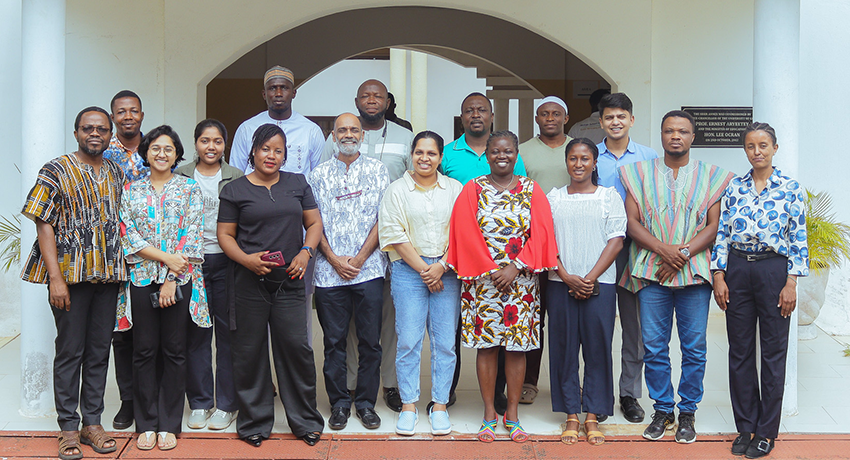
Participants and trainers at ISSER ahead of the Weta fieldwork.
The Institute of Statistical, Social and Economic Research (ISSER) collaborated with the International Development Economics Associates (IDEAs) to coordinate 10 days of fieldwork as part of the 2025 IDEAs Advanced Certificate Programme on Research in Political Economy. IDEAs is pluralist network of progressive scholars in economics, development studies, sociology, political science and related disciplines. The group is dedicated to research, teaching, and dissemination of critical analyses of economic policy and development.
The fieldwork, an important component of the Advanced Certificate Programme, brought together 12 participants from Ethiopia, Ghana, Namibia, Nigeria, and Zambia -- along with three alumni from India and one alumnus each from Ghana and Zambia -- to examine agrarian livelihoods, local political economy dynamics, labour relations, and value-chain structures in rural Ghana.
Students departed for fieldwork on 1 December and returned on 11 December 2025 after a one-week workshop during which the research questions and instruments were finalised. The research sites were located in the Ketu North and Keta Municipalities of the Volta Region, chosen for its concentration of rice farming, rice milling, and salt production.

Participants conducted research across 11 communities, engaging a wide range of stakeholders through semi-structured interviews, focus group discussions, and field observations. The fieldwork was conducted under the supervision and guidance of Dr. Kofi Takyi Asante, Dr. Dzifa Torvikey, and Prof. Fred Dzanku.
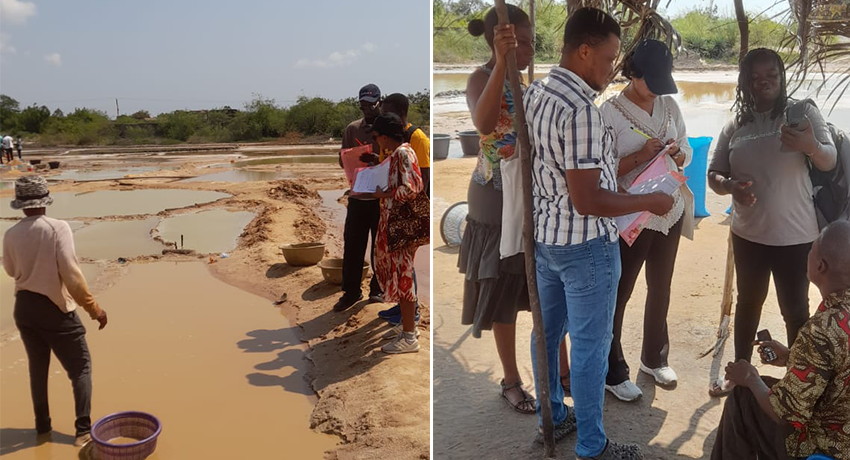
Reflecting on the experience, Dr. Torvikey said, "It was heartening to see participants apply classroom learning to real-life contexts, engage with local realities, and reflect on the factors shaping rural development."
Key activities included meetings with officials from the Ketu North Municipal Assembly’s Department of Agriculture, discussions with the Irrigation Development Authority, and interviews with rice farmers, mill workers, and salt production workers. The team also engaged with Diamond Solar Salt Company Limited to examine how the entry of corporate actors affects local production dynamics, labour relations, and market competition.
Students collected data on several themes, including rural livelihoods, including land access and ownership, gendered divisions of labour across rice farming, milling, and salt production, and the strategies small-scale producers employ to cope with market pressures, climate variability, and infrastructure challenges.
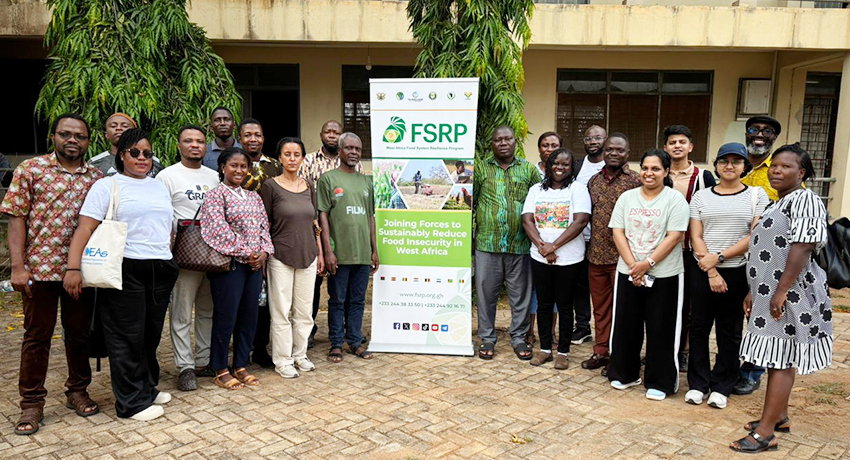
The 2025 - 2026 cohort is the fourth since the start of the IDEAs Advanced Certificate Programme, which is designed to train postgraduate students in political economy research with an emphasis on heterodox approaches to development studies. The programme combines foundational courses in macroeconomics, development economics, and research methods with practical fieldwork and optional specialised courses.
"ISSER is delighted to coordinate this important fieldwork component and remains committed to supporting future collaborative research training that bridges academic rigour with grounded field engagement," noted Prof. Dzanku.
- Log in to post comments